
Won Ch. Kimetarx
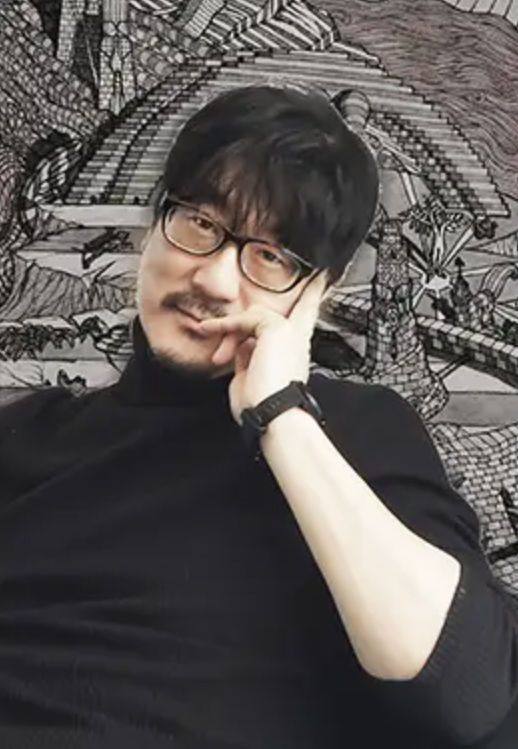
Entering Kimetarx’s artistic universe is like stepping into a secret clearing within an architectural forest—a place where imagination takes root and flourishes freely. Rejecting traditional approaches focused solely on spatial design, Kimetarx merges the codes of architecture with the creative impulse of visual art to construct new narratives. His works are not mere pictorial representations; they become speculative illustrations, grounded in the theoretical, narrative, and graphic principles of visionary, narrative, and paper architecture.
Kimetarx’s style blends speculative architecture with a biomorphic and narrative aesthetic. Organic and modular forms evoke totemic or anthropomorphic figures, enveloped within architectural grids reminiscent of digital frameworks or futuristic structures. Each composition seems to emerge from a parallel world where built space interacts with fiction and science. Technical elements, annotations, cross-sectional views, and mathematical symbols reinforce the impression of plausible architectural projects, while preserving a strong poetic and critical dimension. This hybrid visual language challenges the boundaries between art, design, and visionary architecture.
This architectural series by Kimetarx explores a speculative and symbolic dimension of architecture, where structures become hybrid entities—part organic, part mechanical. Each work appears to spring from a utopian dream or a technological nightmare, merging bodies, buildings, and urban landscapes. Elongated, monumental forms recall totems or ritual artifacts, while textures and geometric patterns suggest the influence of visionary architecture and science fiction. The artist subverts classical functions of the built environment to create a narrative language: anthropomorphic skyscrapers, serpent bridges, machine phalluses, and matrix cities form an allegorical commentary on power, desire, and collective memory. The series implicitly critiques standardized urban planning while celebrating imagination as a means to reconstruct the world. These visions, simultaneously futuristic and archaic, question the relationship between humanity, territory, and architecture in an era of transformation.
Artistic Statement
I explore architecture through art. This artistic intervention is not merely a formal proposal but a speculation on artistic things in the world. My work allows the architectural piece, as an individual, to appear in reality.
My practice is neither artistic architecture nor architectural art. It makes possible embodied architecture—the central theme of my work—and fantasized architecture—its methodology. Buildings, imbued with fantasy, take form in the world.
To achieve this embodiment, I explore a speculative approach on various surfaces, arranging architectural “things.” Through the combination of lines and monochrome or limited-color surfaces, individual objects reveal themselves both artistically and architecturally.
I aim for each building, created in resonance with my artistic intention, to vibrate with the viewer. These objects, coexisting rather than serving humanity, open new visions of coexistence and its participants.
This perspective draws inspiration from visionary architecture and paper architecture. As an artist-architect, I seek to transcend these traditions through artistic speculation, creating an art-architecture in which both fields resonate together.
My small-format works, 4 x 6 inches, illustrate this speculation. A single object reveals its essence, substance, and existence. In the triptych, each element, distinct yet connected, resides in mutual resonance on the same plane. The architectural things present continue to unfold here and now, coexisting with you.
Artistic Statement
I explore architecture through art. This artistic intervention is not merely a formal proposal but a speculation on artistic things in the world. My work allows the architectural piece, as an individual, to appear in reality.
My practice is neither artistic architecture nor architectural art. It makes possible embodied architecture—the central theme of my work—and fantasized architecture—its methodology. Buildings, imbued with fantasy, take form in the world.
To achieve this embodiment, I explore a speculative approach on various surfaces, arranging architectural “things.” Through the combination of lines and monochrome or limited-color surfaces, individual objects reveal themselves both artistically and architecturally.
I aim for each building, created in resonance with my artistic intention, to vibrate with the viewer. These objects, coexisting rather than serving humanity, open new visions of coexistence and its participants.
This perspective draws inspiration from visionary architecture and paper architecture. As an artist-architect, I seek to transcend these traditions through artistic speculation, creating an art-architecture in which both fields resonate together.
My small-format works, 4 x 6 inches, illustrate this speculation. A single object reveals its essence, substance, and existence. In the triptych, each element, distinct yet connected, resides in mutual resonance on the same plane. The architectural things present continue to unfold here and now, coexisting with you.
