2001, The Odyssey of Hélène Goulet
From October 4th to November 4th, 2025
At Éclats Contemporary Art
Opening on October 7
Guests of Honour:
Dr. Mounir Samy (psychiatrist)
Matt Herskowitz (musician)
Curator: Professor Norman Cornett
With the selection of curator Norman Cornett, the exhibition highlights a pivotal stage in Hélène Goulet's career. The works presented, created between 1995 and 2001, trace the intimate cartography of an artist who transforms painting into a territory of exploration. Freed from the weight of the figurative, her canvases reveal a breath that asserts itself with each composition. The visitor is invited to enter a universe where art becomes a language of emotions and invisible forces. This exhibition offers an immersion into the creative power of an artist in full affirmation of her vision.
The pictorial odyssey of a lyrical abstraction (1995-2001)
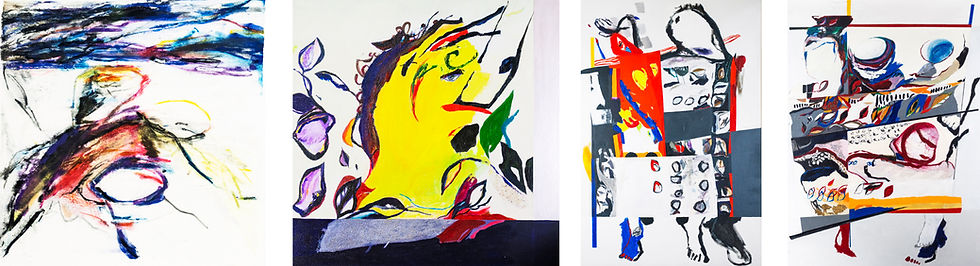
The period 1995–2001 in Hélène Goulet’s work marks a pivotal stage in which a gestural liberation and a will for chromatic structuring crystallize. It is a passage where figuration—still present through fragments and allusions—gradually gives way to a lyrical abstraction nourished by spontaneous impulses and organic resonances. The canvases of this period reveal a profound questioning of memory, the human condition, and the fragility of existence.
Color as Living Matter
The first element that strikes the eye is color. Goulet works with primary hues with singular boldness: red, yellow, blue, and orange unfold, oppose, and overlap in tense compositions. Harmony is born of confrontation. Yellow, often central, acts as an incandescent core around which other tones gravitate. This chromatic energy evokes the organic vitality of a vibrating substance. Color becomes vital energy.
Gestural Energy and Automatic Writing
To this dynamic of color is added the power of gesture. The black, fragmented lines seem laid down in urgency, like an automatic writing guided by instinct. They energize the canvas, inscribing a temporality of the instant. Goulet does not simply repeat a gestural rhetoric: she seeks to balance spontaneity and construction, emotion and inner structure. Each brushstroke retains its raw intensity while contributing to a coherent pictorial language.
Fragmented Body, Shattered Memory
Within this tumult of colors and gestures emerge human fragments: an unfinished head, protruding feet, a suspended hand, truncated silhouettes. These elements never recompose into a unified figure. They offer a dispersed, vulnerable body, subjected to the violence of time and history. This fragmentation evokes both the splintering of the contemporary image and a meditation on the fragility of flesh. Memory is never given whole: the white surfaces, the unfinished zones function as visual silences, reminding us that what we retain of the past is always marked by absence and ellipsis. The visible and the invisible coexist.
Between Figuration and Abstraction
One of the strengths of this period lies in the refusal of clear boundaries. Goulet deliberately blurs reference points. On one hand, one recognizes forms that evoke skulls, shells, insect wings, masks, or hearts. On the other, these same forms shift into abstraction, dissolving into gesture and color. This constant oscillation creates a fertile tension between rationality and sensibility. The viewer is thus placed in an active position of interpretation: it is up to them to complete their own figures within the work.
Metamorphic Resonances
Another striking aspect resides in the metamorphic dimension of the forms. Black and green arabesques, hybrid color masses seem to give birth to vegetal or animal creatures. The canvases breathe an organic imagination, united by a shared dynamic of transformation. The works evoke passages from one form to another, as though the artist sought to reinvent a symbolic language.
Fragility and Vitality
Despite the fragmentation and vulnerability they express, these paintings are not somber. The flamboyant use of primary colors infuses an almost festive energy. A fundamental tension can be perceived: on one side, the fragility of an existence exposed to violence; on the other, the persistence of a luminous force that refuses erasure. Goulet thus translates the human condition in its dual dimension—vulnerable and vital, fragile yet resilient.
A Phase of Transition and Inner Odyssey
This 1995–2001 period marks a decisive transition. The artist moves away from explicit figuration and landscapes to dive into an abstraction where color becomes the true subject and form a pretext for exploration. What is sought is not a stable image but the capture of a transformation. Each canvas reads as the fragment of an inner odyssey—a traversal of pictorial matter conceived as a vehicle for emotion.
Conclusion
Hélène Goulet’s paintings from the late 1990s reflect a process of deconstructing the figurative image and reinventing an inner landscape. They bear witness to a lyrical abstraction where color and gesture express the tension between vulnerability and vitality. They position painting as a site of experience where memory, the body, and imagination intertwine. This period stands as a plastic meditation on the human condition—a quest for life at the heart of fragility.
The Goulet-Lemoyne relationship
The death of Serge Lemoyne in 1998 certainly marked a turning point in Hélène Goulet's career, both personally and artistically. The loss of a companion who was also a creative partner may have provoked a profound questioning. The absence of Lemoyne, with whom Goulet shared an intellectual and artistic complicity, undoubtedly left a void that she may have sought to fill through an intensification of her pictorial gesture and formal research. Mourning is often transposed into art through a new energy, where the artist transforms pain into expressive force.
Continuity and resonance
The creative dialogue between Lemoyne and Goulet did not end with his death, but shifted. One can imagine that Goulet pursued certain questions he had begun with him, like a deferred response. His painting from the late 1990s shows a tension between chromatic brilliance and meditative interiority: a dialectic that could reflect the need to keep alive the breath shared with Lemoyne, while asserting his own path.
Sublimation through color and gesture
In Goulet's work, color sometimes becomes a luminous focus; the organic and fragmented forms translate a quest for meaning beyond loss. This sublimation through pictorial matter can be interpreted as a work of mourning: transforming the lost intimacy into a sensitive and visual memory.
Artistic expression
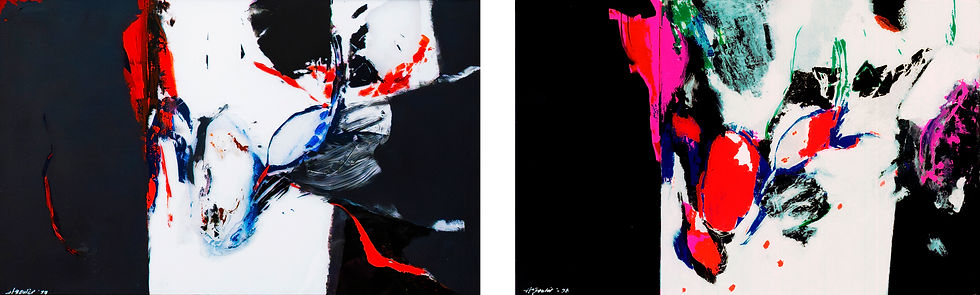
The series "Fleurs outrageantes" are among the very first paintings she created after the death of Serge Lemoyne. These works are made in mixed media on Plexiglas. We observe a marked contrast between dark hues (black, blue, red, white) and a "violent" execution that makes the rage almost palpable. This series translates through pictorial material the clash of emotions, the cohabitation of clumsy beauty, unspeakable pain and vital impulse (L'espace à cœur ouvert by François Escalmel, 2000, Vie des arts).
Summary
Hélène Goulet's works, created between 1995 and 2001, represent a decisive step in her artistic career. They reflect a visual research where gestural energy and the power of color combine in a constant tension between figuration and abstraction.
Color plays a central role: red, yellow, blue, and orange are used with intensity and boldness. Yellow, often luminous, acts as a solar focus around which the other shades are organized. Color becomes a living material that infuses the paintings with a festive vitality.
The compositions are crossed by fragmented black lines, close to automatic writing. They introduce a raw gestural dimension, mastered by a search for internal structure. This gestural quality is accompanied by human fragments, an unfinished head, hands, feet, truncated silhouettes that recall the vulnerability of the body. These bodily remains bear witness to a fragmented being, traversed by time.
Goulet's painting also suggests metamorphoses: ovoid shapes evoking skulls, shells, wings, or masks, arabesques that hint at hybrid creatures. The white areas function as visual silences, revealing that memory is composed of absences and traces.
These works reflect a transitional phase: the artist moves away from figuration and landscape to immerse himself in a lyrical abstraction where color becomes the subject, and form, a pretext for exploration. Goulet seeks to capture movement and transformation. This period reveals a true inner odyssey: a gestural and organic painting, where human fragility and vital force meet in a pictorial language of rare intensity.